

Turning student projects into community-facing prototypes, this article shows how universities can deliver measurable Third Mission impact through responsible design.
Higher education’s “Third Mission” is often framed as engagement, knowledge transfer, and societal contribution beyond teaching and research. For entrepreneurial and engaged universities, two practical standards help make this ambition operational: Impact the direct and indirect, short- and long-term value universities create for communities and partners; and Education the quality of entrepreneurship learning opportunities, including how external stakeholder input is integrated into the design, delivery, and evaluation of programs.
In practice, I have found the Third Mission becomes real only when we design learning as an impact journey: students are guided to solve authentic problems, validate outcomes with stakeholders, and communicate value in a form that can travel beyond the classroom. Over the past year, my work has centred on a consistent managerial question: what changes when we treat student projects and teaching innovation not as internal academic activities, but as community-facing prototypes—built with responsibility, measurable outcomes, and a clear pathway to adoption?
When the classroom becomes a bridge to public value
A defining highlight was supervising a mobile-first skin cancer detection prototype that demonstrated how student capability can translate into public benefit. The project matured beyond a typical assessment deliverable into a solution framed around a real social need: helping users detect risk earlier, prompting timely medical consultation, and expanding awareness through accessible technology. Recognition through an external award ecosystem provided an important signal not simply that the technology “worked,” but that university-led innovation can be legible and credible to the wider community when it is built with purpose and validation.
This is the heart of my approach to entrepreneurship in higher education: entrepreneurship is not only about startup formation. It is the discipline of choosing meaningful problems, building usable solutions, testing assumptions with evidence, and iterating based on real-world constraints. When students experience that process, they begin to see themselves differently not as learners completing tasks, but as builders creating value.
PTESmart: expanding access to speaking practice through responsible AI
Source: https://youtu.be/NFkb4BEBvt8;https://youtu.be/NFkb4BEBvt8
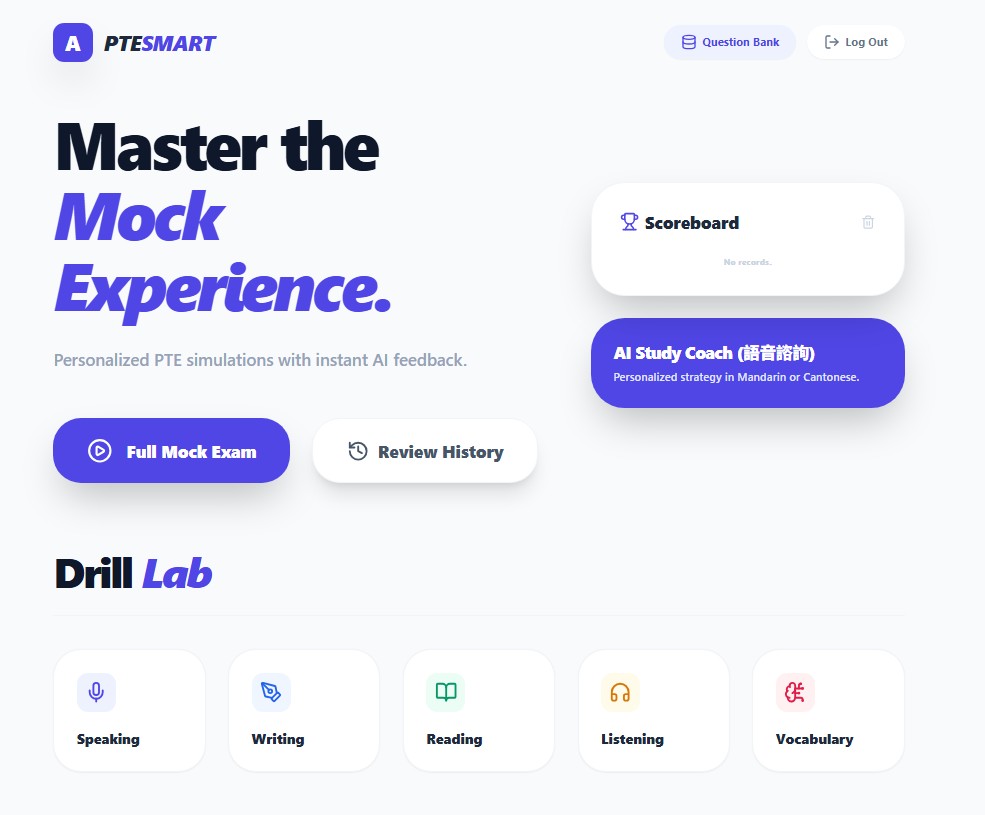
In parallel, I shifted focus to language-learning equity through PTESmart, an AI speaking tutor designed specifically for PTE Academic preparation. The practical problem is well known among learners: speaking proficiency improves through consistent practice and targeted feedback, yet many students face barriers such as cost, limited access to qualified tutors, inconsistent feedback quality, and confidence anxiety especially when they do not have a safe environment to speak regularly.
PTESmart is built as an always-on speaking partner that supports the structure and expectations of the PTE exam. The design is intentionally aligned to PTE speaking task types such as Read Aloud, Repeat Sentence, Describe Image, Retell Lecture, and Answer Short Question. Rather than functioning as a generic chatbot, the system is positioned as a coached practice loop: the learner attempts an item, receives feedback mapped to PTE relevant dimensions (for example pronunciation, oral fluency, and content coverage), and is guided through correction and repetition to build improvement over time.
This becomes a Third Mission initiative when access is treated as the primary impact objective and the solution is designed to travel beyond an individual classroom. In Impact terms, PTESmart aims to generate direct, short-term value (more frequent, structured speaking practice) and longer-term value (greater learner confidence and improved readiness for further study and work). In Education terms, it operationalises entrepreneurship learning by translating a real learner pain point into a tested service concept one that can be iterated with external input (for example students, language trainers, and education partners) and evaluated through practical indicators such as usage consistency, feedback usefulness, and measurable progress over time.
From an entrepreneurship perspective, PTESmart also demonstrates a shift from “building a tool” to “building a responsible, adoptable product.” The project is framed by responsible AI principles clear positioning as a learning support tool rather than an official scoring authority, careful handling of user data, and transparency in how feedback is generated so that trust, governance, and stakeholder confidence become part of the product design, not an afterthought.
The overlooked third mission: teacher enablement and assessment quality
While community impact is often framed externally, a substantial part of “service to society” in higher education occurs through improving the systems that shape learning quality at scale—especially assessment and teaching operations. This is directly linked to the ACEEU standard Education, which emphasises entrepreneurship-oriented educational opportunities and the integration of external stakeholder input into the design, delivery, and evaluation of study programmes.
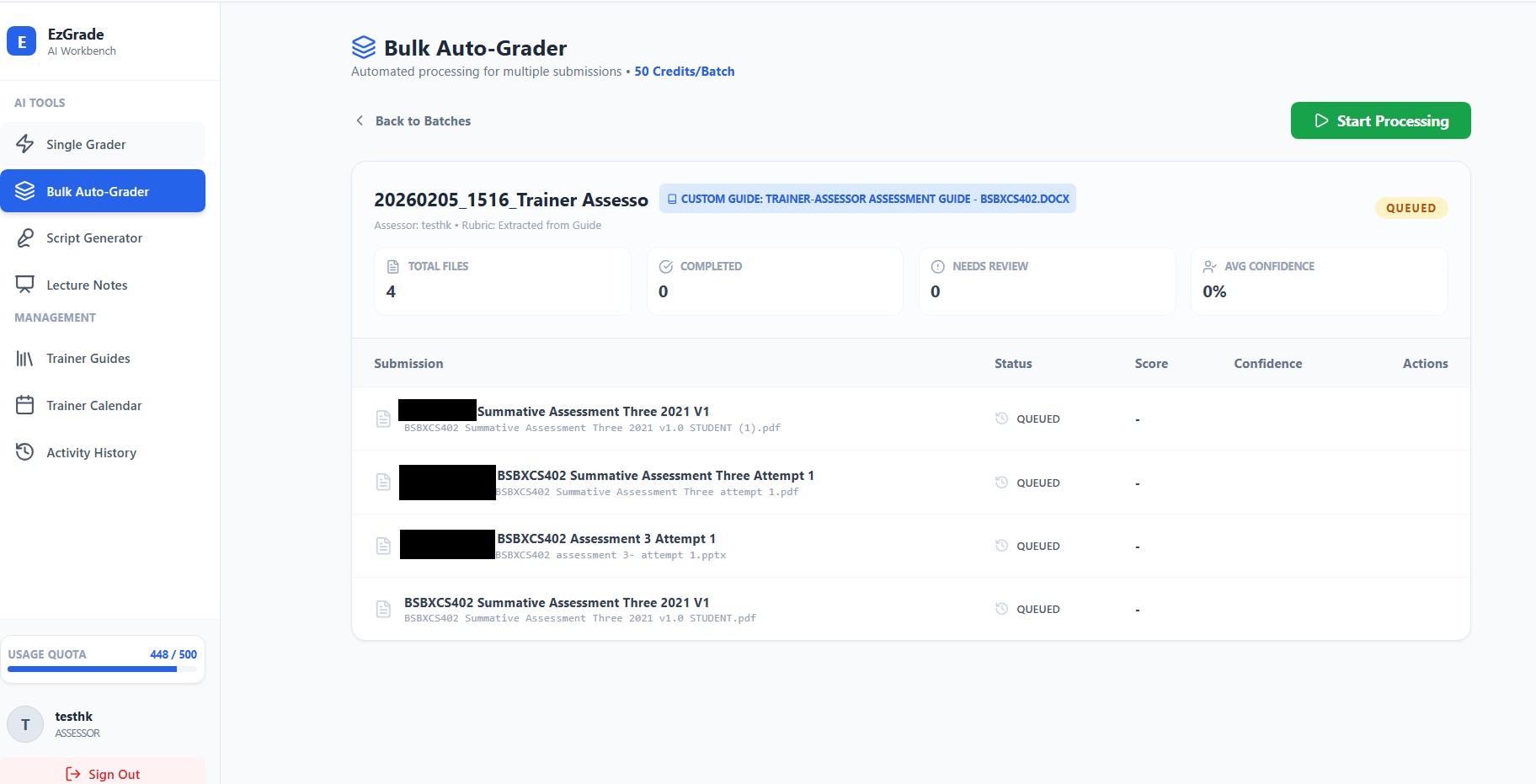
This is why I invested significant effort into EzGrade, a teacher-centred assessment management platform prototype. The target users are educators who operate under real constraints: complex assessment workflows, compliance requirements, moderation and audit needs, and increasing workload pressure. EzGrade’s concept architecture includes role-based access control, audit logging, AI-assisted unit and rubric drafting support, lecture note preparation workflows, and a personal teaching calendar integrated into a single platform vision.
 Source: https://youtu.be/qaxVLSFjHHA
From an Education perspective, EzGrade supports more than efficiency—it strengthens the conditions for high-quality learning design and fair evaluation. By improving auditability, workflow clarity, and rubric consistency, it enables educators to devote more time to meaningful feedback, formative support, and learning activities that build employability and entrepreneurial capability. It also creates a structure where external stakeholder expectations (for example, industry competency requirements, placement supervisors, professional standards, and accreditation demands) can be translated into assessable criteria and continuously refined through evidence—closing the loop between programme intent and real-world relevance.
The intention is practical: when educators spend less time on repetitive administration and more time on feedback quality and student support, the downstream impact is large. This form of innovation is often underestimated in “entrepreneurship” narratives, yet it is among the highest-leverage pathways to educational quality, student retention, and fair assessment.
A replicable best-practice model for engaged entrepreneurship education
Across these initiatives, a repeatable model has emerged one that supports Third Mission outcomes without requiring a large institutional footprint.
First, start with authentic, lived pain points that students can observe and test, not hypothetical ideas. Second, build prototypes with governance and responsibility designed in from day one access controls, auditability, and clear boundaries about what the tool can and cannot claim—so that stakeholders can trust the work and adoption becomes possible. Third, validate impact early using simple but credible measures (for example uptake, engagement, feedback quality, and evidence of improved outcomes), and iterate based on evidence rather than assumptions. Finally, create continuity by designing project “heritage,” so each cohort improves the next version instead of restarting from zero.
Taken together, these steps help convert learning outputs into sustained impact: short term, direct benefits (usable tools, improved learning experiences, immediate stakeholder value) and long-term, indirect benefits (stronger institutional capability, more employable graduates, and scalable practices that can be reused across contexts).
Reflection: the real outcome is a new graduate identity
Awards, prototypes, and platforms are important, but they are not the deepest success metric. The most meaningful change is when students develop a durable identity as professionals who can improve system health, learning, assessment, and service delivery using technology responsibly.
For higher education leaders, the challenge is to move beyond viewing the Third Mission as an “extra” activity and instead manage it as a design principle embedded in programme operations. The practical take-home message is this: if we want consistent university impact, we must design learning systems that reliably produce it. That means aligning to the ACEEU Education standard by integrating external stakeholder input into the design, delivery, and evaluation of entrepreneurship-oriented learning opportunities and aligning to the ACEEU Impact standard by making outcomes visible across direct and indirect, short-term and long-term dimensions.
When these two standards are treated as management requirements rather than aspirational language, the Third Mission becomes practical: graduates who do not only understand concepts, but can build solutions, validate impact, and contribute to communities with confidence and competence while universities build repeatable capability for sustained societal value.
.

.
Images courtesy of the author