
Designing a new academic program from scratch is not for the faint of heart and it is a particularly difficult task to accomplish in a small, remotely located university that holds on to tradition, disciplinary specialisation, and conventional standards of academic rigour. There are a number of factors that spark program innovation, the most frequently listed being the following: addressing a gap in academic programming; gaining a competitive advantage regionally, nationally, or internationally; adapting to social, cultural, and technological changes or industry shifts; driving long-term growth (e.g. through a flagship program); creating new interdisciplinary connections within an institution; and reasons pertaining to a specific educational establishment, such as a need to reassign faculty or reinvest resources.
To a variable degree, all these factors played a role in the creation of the Visual and Material Culture Studies Program (VMCS) at Mount Allison University, but more important was our desire to be innovative and relevant as educators in the 21st century. Our university offered no pathways to building visual and material literacy and it was important for us to see this conspicuous gap addressed through the academic programming we offered our students.
The argument that I would like to make is that a 21st-century university cannot be entrepreneurial, engaging, and relevant without program development and to foster it, an institutional framework needs to put in place to ensure that not only is there a template and support for it but also faculty are incentivised to bring forward proposals and develop place-specific programming. This is an approach that aligns with the ACEEU Standard Education, which emphasises innovative, relevant, and impact-driven learning environments.
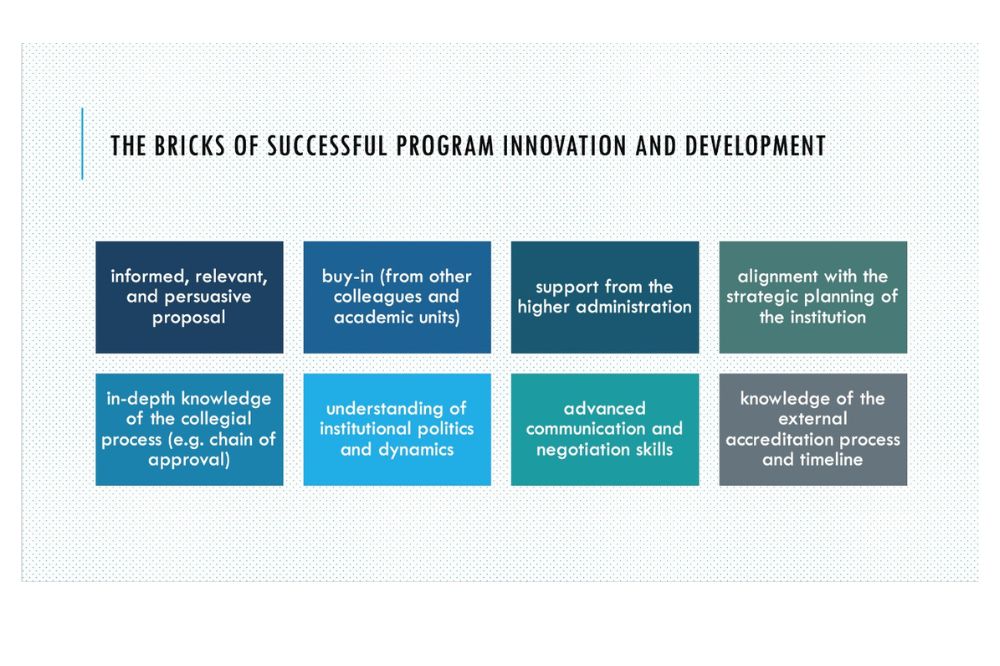
Figure 1. The Bricks of Successful Program Innovation and Development, diagram created by Christina Ionescu, 2025.
Recruitment of both academic and non-academic employees is tied to opportunities for professional development and advancement offered to them within the hiring institution, an issue that speaks directly to ACEEU Standard Staff Profile. When accepting an employment offer, however, faculty are not necessarily aware of opportunities for program development in their new place of work. In the Arts and Humanities, where tenure-track positions are particularly scarce in Canada and appointments are generally made at the rank of Assistant Professor, other considerations will certainly be deemed more important by prospective applicants (teaching vs. research institution, salary, benefits, location, etc.). Program development is not normally undertaken by faculty in the early stages of their careers as they tend to focus on meeting the requirements at first for tenure and then promotion to full professorship. Program development requires an entrepreneurial spirit and demonstrates deep investment in education and student success. While our institution has always excelled at providing faculty with opportunities to hone teaching skills through the Purdy Crawford Teaching Centre and recently began to expand targeted practical training through Extended Learning, establishing VMCS as a program was conducted in uncharted waters – in the absence of a formal template for program development and without a recent precedent to guide the process of collegial approval.
If an institutional purpose is always formally provided for program development, what personally motivates faculty to devote their time to this endeavour is not often shared – that information normally surfaces in off-the-record conversations and occasionally on social media. What is certain is that most program architects do not undertake the development of a new program due to incentives or rewards offered by institutions – if these even exist – though recognition can be received in other ways. This reality stands in contrast to ACEEU Standard Incentives and Rewards, which emphasise the importance of formally recognising and incentivising entrepreneurial and engagement-oriented contributions by academic staff.
Instead, career stagnation acts as a powerful driving force, as does the desire inspiring faculty who want to contribute meaningfully by pedagogical means to seek an outlet to share with students their knowledge and excitement about an area of study that may fall outside of traditional disciplines, but which seems particularly relevant to them and beneficial to society in general. It could be in a domain in which they may have developed, perhaps gradually and in a curiosity-driven manner, critical expertise through their interests and research projects.
When a faculty member teaches the same courses yearly or on rotation, is confined by disciplinary approaches and pedagogical objectives that are no longer a fit, or has reached the end in the promotion echelon, what are their options professionally? They can certainly choose to invest more time into research, increase their service to the university or external organisations that matter to them through consultative or committee work, or embark on the administrative path. We have all seen unmotivated colleagues who appear, however, to detach themselves from teaching, retreat in their Ivory Towers, and count the years before retirement. The system in which we as faculty operate is distinct from that of other professions where employment opportunities are more widely available: after tenure, faculty mobility, for example, is severely limited in countries like Canada and those who do not fit in their current work environment or seek a career change cannot necessarily combat lack of motivation with relocation.
The mechanics and logistics of creating a new program are complicated and institution-dependent, but it all starts with articulating a persuasive argument for this endeavour and adopting an entrepreneurial mindset. In December 2018, I drafted the proposal for a new program in Visual and Material Culture Studies, contending that the world in which our students live is dominated by images and visual media. I argued that it has thus become vital in university education to equip students with the knowledge and skills to think critically about images and visual media, to understand how they construct and communicate meaning, to assess their persuasive and emotive functions, and to use them efficiently and creatively in real-life contexts. Similarly, our 21st-century world is saturated with objects – consumer products, technological devices, luxury items, museum artefacts, digital objects, etc. Students must learn how to deconstruct their own connections to the material culture that surrounds them and to understand the role that objects and built structures play in their lives. Visual Culture Studies and Material Culture Studies typically operate independently of each other in scholarship and universities, thus combining the two theoretically, methodologically, and pedagogically is what renders this program unique.
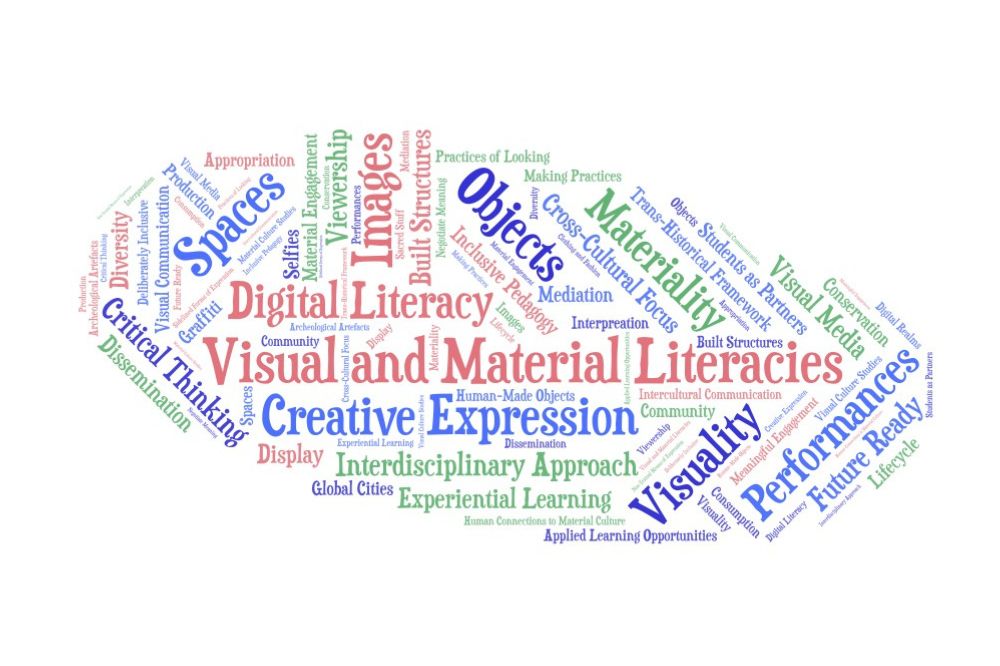
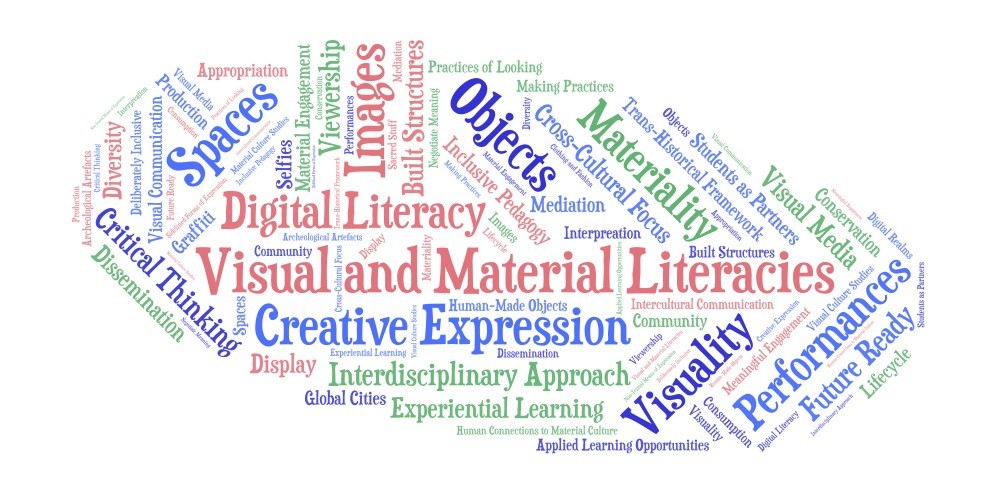
Figure 2. Creative cloud featuring the objects of study, learning outcomes, and defining traits of Visual and Material Culture Studies as a new interdiscipline and academic program.
Approved by Senate in Spring 2019, VMCS became a dynamic and thriving program at Mount Allison University, a program unique in Canada and the world in that it connects the visual and the material through its strong interdisciplinary core. A defining trait of this original program is that it reflects a shift away from the interpretation of texts and verbally-supported ways of knowing, which have traditionally formed the foundation of the Humanities and Social Sciences, and toward an examination of images, objects, spaces, and performances. As we developed this program, fostering students’ visual and material literacy would become the strongest and most persuasive objective underlying our collective mission, one that resonated with students, faculty across the board, administrators, and other stakeholders. The success story of the VMCS Program demonstrates that at a time when the Arts and Humanities are plagued with decreasing enrolments and must make a case for purpose, there are ways in which universities can reinvent themselves through program development that appeals to 21st-century students. To provide an opportunity to acquire a micro-credential relevant to industry, I also designed the Certificate in Visual Literacy and Culture, the first of its kind to have an interdisciplinary and cross-cultural orientation, without being anchored in Art History or Design Studies; it has become the most popular certificate at Mount Allison University.
Figure 3. Enrolment growth of the VMCS Program from Fall 2019 to the academic year 2024-2025.
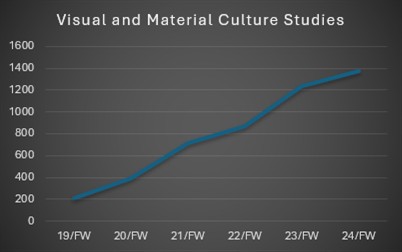
Note: The Mount Allison University enrolment is approximately 2,300 students per year. Students normally enrol in ten courses yearly.
Program innovation and development is a time-consuming endeavour that entails career sacrifices. It can be a frustrating experience if undertaken in an institutional culture resistant to change or lacking resources to support new programs. It cannot happen without strong advocacy from the senior administration and buy-in from other colleagues and/or academic units. Nonetheless, when it succeeds, as VMCS remarkably did, exceeding all initial expectations, it can render the university classroom relevant and reenergise faculty members by giving them a space to break free from disciplinary chains and channel their passion into visionary and entrepreneurial teaching that has an impact on students, the institution, and the world. University administrators would do well to support program innovation as an antidote to faculty apathy, boosting engagement and morale by empowering successful educators to design programs that are not only relevant to students and opportune to a higher education establishment but also personally and professionally meaningful to those who spearhead them. A university that seeks to be engaged, entrepreneurial, and relevant must champion program development and support faculty who devote their time to it.
Taken together, this experience speaks directly to ACEEU Standards Staff Profile, Incentives and Rewards, and Education, underscoring the need for institutional cultures that recruit and develop engaged staff, recognise and reward entrepreneurial academic work, and enable innovative, future-oriented learning environments.
The Ultimate Guide to Canadian Universities, https://macleans.ca/education/university-rankings/
Patti Dyjur, Allyson Skene, Cary Dipietro, Kathleen Fitzpatrick, Kimberley Grant, Carolyn Hoessler, Frances Kalu, Jessie Richards, and Peter Wolf, ED Guide No. 4: A Comprehensive Guide to Working with Higher Education Curriculum Development, Review & Renewal Projects, Educational Development, 2022.

.
Images courtesy of the author