
Contemporary transformations in access to justice and the third mission of universities
Paradigmatic shifts in access to justice and university outreach place the university, particularly its institutional leadership, at the center of governance, innovation, and societal engagement strategies. When intentionally incorporated into the university’s strategic planning, these agendas cease to be isolated initiatives and become integrated into management models that reflect the ACEEU standards of Institutional Commitment, Service Alignment, and Influence within the Ecosystem.
In this context, amid a persistent global landscape marked by violence, armed conflicts, and systemic crises, the right of access to justice, the unit of analysis of my master’s research, transcends the mere possibility of resorting to the Judiciary. It also encompasses education, the prevention of violence, the promotion of human rights, and the construction of more equitable and prosperous societies. The theoretical waves of access to justice (Cappelletti & Garth 1988; Economides 1999) have expanded this concept, opening space for social, technological, and community dimensions, encompassed under the umbrella of Third Mission of universities (Santos, 2024).
In Brazil, the mandatory curricular integration of university outreach programs (Resolution CNE/CES No. 7/2018) offers universities the opportunity to transform education in Law and related fields into spaces of innovation. Universities that embrace this commitment in an innovative and collaborative manner become strategic actors in strengthening democracy, aligning their practices with the United Nations’ Sustainable Development Goals (SDGs).
Thus, when university extension activities are articulated through collaborative networks and guided by the diversity paradigm, they can contribute to an innovation ecosystem that incorporates access to justice — that is, practices grounded in the protection and effective realization of fundamental and human rights — as a strategic component of innovation processes, connecting civil society, companies, governments, universities, and vulnerable communities in genuine processes of social transformation. This means practically assuming a public and strategic commitment written into the Brazilian constitution in 1988, according to which universities must be guided by the principle of the indissociability of teaching, research, and outreach.
To achieve this, connections must be plural and multidirectional, linking ideas to actors capable of stimulating genuinely transformative action-actors qualified to challenge structural paradigms of competitiveness and to prioritize collaboration instead, in a world that urgently requires unity. To contribute to this objective, this article presents Cosmos: Network for Access to Justice and University Outreach, a proposal aligned with the ACEEU standards that highlights the university’s role beyond institutional boundaries.
The untapped potential of university outreach networks in higher education
University outreach projects often operate in isolation, driven by the initiatives of individual faculty members or small groups of students. This fragmentation reduces their potential for social impact and renders invisible practices that could otherwise be scaled nationally and internationally (Santos, 2024).
However, by forming outreach networks, universities can leverage their resources and expertise cooperatively, as fostered by ACEEU standard Service Alignment. This network-oriented logic enhances their capacity to provide free legal assistance to vulnerable groups, promote education on human rights, develop innovative methodologies for violence prevention, and implement integrated socio-environmental practices, as well as promote strategies to support small entrepreneurs, for instance.
Examples such as these were identified throughout my master’s research in Criminal Sciences (2024), in which I interviewed coordinators of university outreach projects focused on access to justice, who reported both advances and challenges in university outreach in Brazil. Based on these data, I mapped the main demands and identified strategic potentialities. Drawing on these findings, and in partnership with AGES: Experimental Software Engineering Agency, at PUCRS, I developed a digital platform that enables interinstitutional communication while simultaneously democratizing access to information for civil society, allowing citizens to identify projects of interest and establish contact whenever necessary.
Access to justice, reputation, and social responsibility
Universities that take a leading role in promoting access to justice - one of the key avenues for generating social impact - reinforce their ethical commitment and institutional reputation. By aligning themselves with the global agendas of the 2030 Agenda and the ESG (Environmental, Social, and Governance) principles, they become strategic partners for governments, businesses, and civil society organizations.
Fortifying an inclusive and innovation-oriented culture of university extension contributes to attracting investments, enhancing the university’s social legitimacy, and encouraging the development of scalable solutions to major contemporary challenges. Inspired by these demands, Cosmos: Network for Access to Justice and University Outreach emerges as a social platform that connects civil society with the university and other strategic actors who, in traditional contexts, tend to remain invisible or underutilized. However, the most significant transformation enabled by this model lies in its potential to expand students’ formative horizons — as central protagonists of this ecosystem — by highlighting multiple pathways for innovation and the reconfiguration of academic, professional, and institutional practices. By expanding its network-driven engagement, the university increasingly educates and sends into the world professionals who are better prepared to address complex challenges, operate in interdisciplinary contexts, generate measurable social impact, and contribute to the development of sustainable, inclusive, and common-good–oriented solutions.
The Cosmos Network
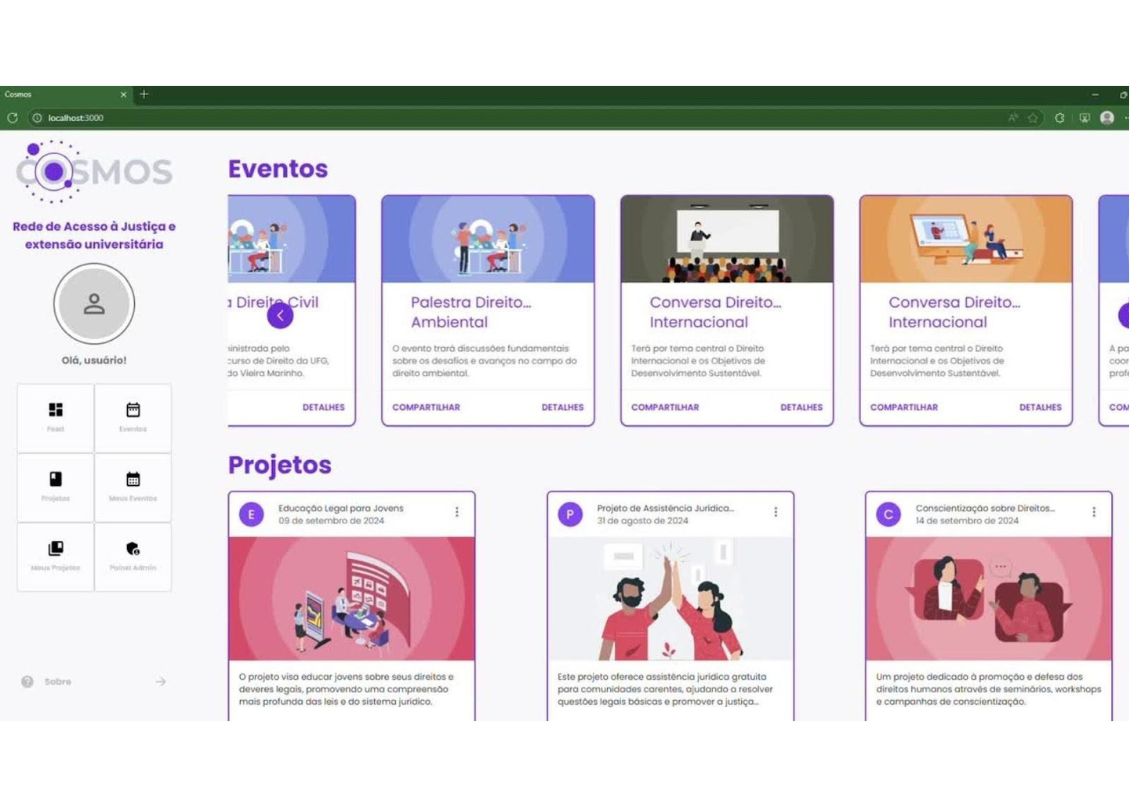
The platform functions as a digital infrastructure that makes outreach activities visible, coordinated, and strategically integrated at the institutional level by centralizing projects, actions, and services in an interface accessible to the broader public. Initiatives are mapped by thematic areas, territories, SDGs, and types of services, facilitating cooperation among faculty, students, and institutions while reducing the fragmentation and isolation that typically characterize these actions, as identified in the qualitative research (Santos, 2024). In addition, Cosmos supports academic management by generating data on social impact, student participation, and adherence to curricularization guidelines for extension projects, enabling universities to transform engagement into a continuous, measurable practice aligned with their institutional strategies for teaching, research, and social responsibility.
The Cosmos model seeks to overcome historical barriers such as the difficulty of locating university outreach projects, institutional fragmentation, limited public investment, and low student engagement. Through technology and a network-based approach, the initiative bolsters collaborative practices and holds strong potential for intersectoral and international expansion.
Figure 1: The Platform
Tangible impact and ripple effects of the cosmos network
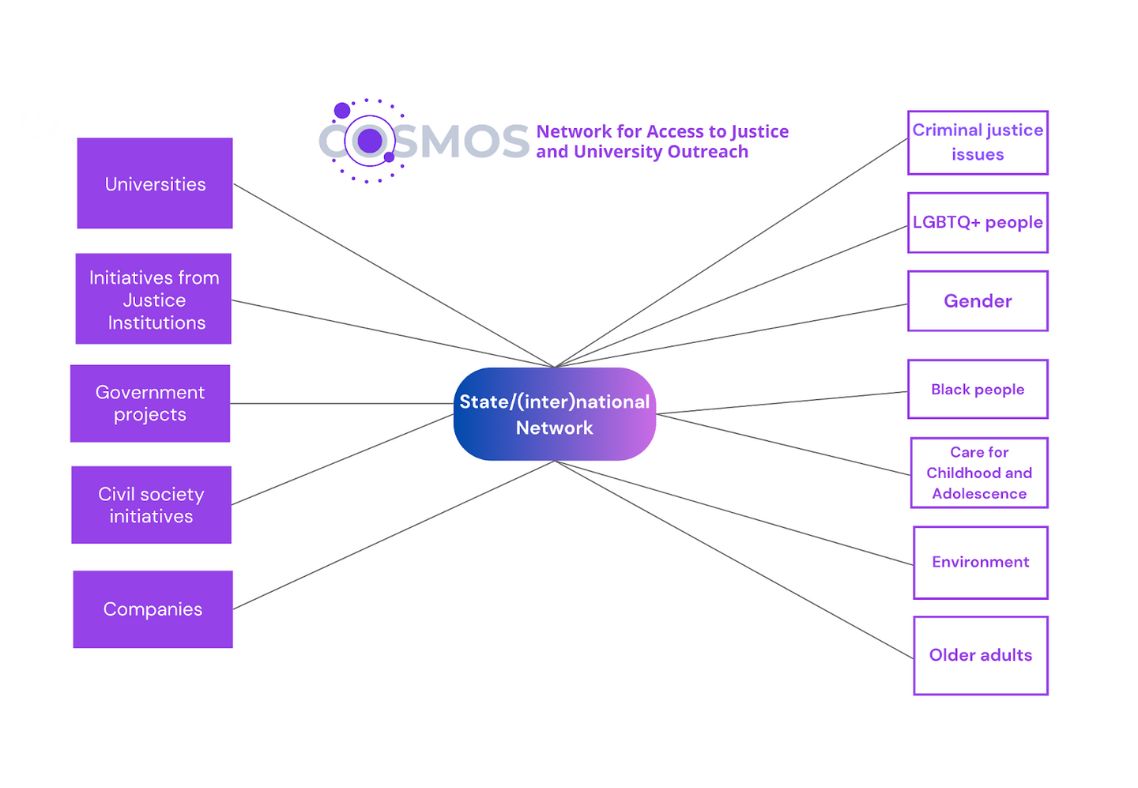
The Cosmos Network can generate multi-level and intersectoral impact by reinforcing collaboration among universities, justice institutions, government initiatives, civil society organizations, companies, and citizens. Through free public access to information and the centralization of initiatives in areas such as criminal justice, LGBTQIA+ rights, gender equity, racial justice, child and adolescent protection, environmental justice, and older persons’ rights, the platform enhances rights awareness, improves service connectivity, and fosters inclusive, data-informed, and sustainable social transformation.
Figure 2: Cosmos’ framework
For universities:
Cosmos has the potential of dynamizing institutional governance by integrating outreach into strategic planning, impact measurement, and curricular innovation. It enhances the visibility of extension initiatives, supports compliance with outreach curricularization policies, and expands opportunities for interdisciplinary learning, student engagement, and applied research. By embedding social impact into academic practice, universities increase their legitimacy, reputation, and alignment with the SDGs and ESG agendas.
For justice institutions and legal aid organizations (e.g. public defenders):
The network facilitates more efficient referrals, interinstitutional coordination, and outreach to vulnerable populations. It broadens the reach of legal empowerment initiatives, supports preventive justice strategies, and improves access to rights-related information, contributing to reduced institutional overload and more responsive, community-oriented justice services.
For government programs and public policy actors:
Cosmos highlights the visibility, integration, and territorial reach of public initiatives related to human rights, social protection, violence prevention, and environmental justice, for instance. By generating structured data on demands, services, and impact, the platform supports evidence-founded policymaking, intersectoral governance, and the scaling of successful social interventions.
For civil society organizations and companies:
The platform creates opportunities for partnerships, sponsorships, pro bono engagement, and corporate social responsibility aligned with social impact goals. Organizations gain access to a structured ecosystem in which they can co-create solutions, strengthen community-based initiatives, and contribute to inclusive development, innovation, and local economic empowerment.
For students and academic communities:
Cosmos expands formative pathways by connecting students to real-world social challenges, interdisciplinary projects, and multi-actor networks. Participation increases employability, civic engagement, leadership, and innovation skills, while fostering ethical responsibility, social awareness, and hands-on experience in justice-oriented and impact-driven initiatives.
For citizens and vulnerable communities:
The system democratizes access to reliable, free, and rights-oriented information, enabling individuals to identify support services, legal aid, educational opportunities, and protective mechanisms. By improving visibility, accessibility, and coordination across initiatives related to focalized groups such as those mentioned above, Cosmos contributes to empowerment, rights realization, violence prevention, and the construction of more inclusive and equitable societies.
Conclusion
This article contended that access to justice should be understood as part of a strategic innovation ecosystem anchored in the universities’ Third Mission, rather than as a peripheral or purely legal concern. By integrating university outreach into institutional strategy, governance, and collaborative networks, universities can expand their influence within broader social ecosystems and become key actors in promoting democracy, social justice, and sustainable development. The Cosmos model illustrates how digital infrastructure and network-grounded approaches can overcome institutional fragmentation, scale social impact, and transform university outreach into a measurable, inclusive and connected practice.
Ultimately, the article challenges higher education leaders to rethink outreach not as an obligation, but as a powerful driver of institutional relevance and societal transformation. From an institutional perspective, this approach exemplifies the principles embedded in the ACEEU standards of Institutional Commitment, Service Alignment and Influence within the Ecosystem, as it demonstrates how engaged university leadership can strategically mobilize multi-actor networks, align outreach with governance and innovation strategies, and position the university as a key catalyst for sustainable, inclusive, and justice-oriented development within local, national, and international ecosystems.
Acknowledgements

Dr Clarice Beatriz Da Costa Söhngen
Professor in the Postgraduate Program in Criminal Sciences
Law school, Pontifical Catholic University of Rio Grande do Sul
Dr Nereu Jose Giacomolli
Professor in the Postgraduate Program in Criminal Sciences
Law school, Pontifical Catholic University of Rio Grande do Sul
Dr Bruno Rotta Aumeida
Professor in the Postgraduate Program in Law and the Graduate Program in History
Law school, Federal University of Pelotas
Dr Bárbara Sordi Stock
Professor of Criminal Law and Criminology
University of Seville
Dr Rodrigo Ghiringhelli de Azevedo
Professor in the Postgraduate Program in Criminal Sciences
Law school, Pontifical Catholic University of Rio Grande do Sul
Dr Maira de Cassia Petrini
Professor in the Postgraduate Program in Administration
Business School, Pontifical Catholic University of Rio Grande do Sul
Marcelo Yamaguti
Coordinator of AGES - Experimental Software Engineering Agency
Polytechnic School, Pontifical Catholic University of Rio Grande do Sul
Flávia Fiorin
Executive Manager
Tecnopuc, Pontifical Catholic University of Rio Grande do Sul
Brazil. (1988). Constituição da República Federativa do Brasil de 1988 [Constitution of the Federative Republic of Brazil]. Presidency of the Republic.
(https://www.planalto.gov.br/ccivil_03/constituicao/constituicao.htm)
Cappelletti, M., & Garth, B. (1988). Access to justice (E. G. Northfleet, Trans.). Porto Alegre: Sergio Antonio Fabris Editor. (p. 7)
Cosmos’ Platform. (s.d.). [Vídeo] YouTube. [https://youtu.be/Xr1M1650fdQ](https://youtu.be/Xr1M1650fdQ)
Economides, K. (1999). Reading the waves of the “Access to Justice Movement”: Epistemology versus methodology? In D. Pandolfi et al. (Eds.), Citizenship, justice and violence (p. 73). Rio de Janeiro: Fundação Getúlio Vargas.
National Council of Education. (2018). CNE/CES Resolution No. 7 of December 18, 2018.
(https://normativasconselhos.mec.gov.br/normativa/view/CNE_RES_CNECESN72018.pdf)
Santos, E. A. dos. (2024). Theory of change applied to the right of access to justice: Challenges and possibilities of an online university outreach network focused on access to criminal justice in the state of Rio Grande do Sul (Master’s thesis, Pontifical Catholic University of Rio Grande do Sul). TEDE PUCRS. (https://tede2.pucrs.br/tede2/handle/tede/11438)

.
Images courtesy of the author